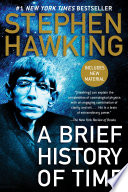
From "A Brief History of Time"
🎧 Listen to Summary
Free 10-min PreviewThe Conceptual Genesis and Early Theories of Black Holes
Key Insight
The term 'black hole' was coined in 1969 by American scientist John Wheeler, though the concept's origin predates this by at least two hundred years. Early scientific discourse on light involved two theories: Newton's particle theory and the wave theory. While both are now understood as correct through the wave/particle duality of quantum mechanics, initial considerations of gravity's effect on light focused on the particle model. The discovery by Roemer that light travels at a finite speed, rather than being infinitely fast, was crucial; it meant that gravity could potentially affect light particles, similar to how it influences other massive objects.
Building on the idea of light as particles influenced by gravity, John Michell, a Cambridge don, proposed in a 1783 paper that a sufficiently massive and compact star would possess such a powerful gravitational field that no light could escape its surface, being dragged back by the star’s attraction. He suggested many such invisible stars might exist, detectable only by their gravity, which are now called black holes. Independently, the French scientist the Marquis de Laplace made a similar suggestion a few years later. Interestingly, Laplace later omitted this idea from subsequent editions of his book, perhaps deeming it too speculative, especially as the particle theory of light lost favor during the nineteenth century, with the wave theory appearing to explain most phenomena.
The application of Newtonian gravity to light particles was problematic because light's speed is fixed, unlike a cannonball whose speed is reduced by gravity. A consistent theoretical framework describing how gravity impacts light did not emerge until Einstein introduced his general theory of relativity in 1915. Even with this breakthrough, it took a considerable period for the profound implications of general relativity, particularly concerning the ultimate fate of massive stars and the formation of objects where light cannot escape, to be fully grasped and developed into the modern understanding of black holes.
📚 Continue Your Learning Journey — No Payment Required
Access the complete A Brief History of Time summary with audio narration, key takeaways, and actionable insights from Stephen Hawking.