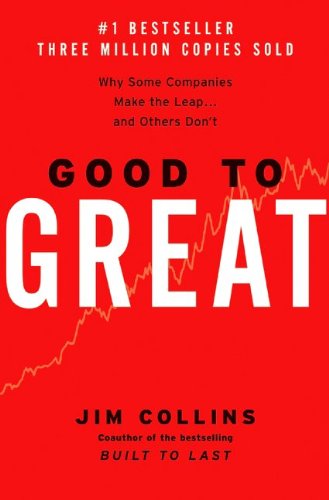
From "Good to Great: Why Some Companies Make the Leap... and Others Don't"
🎧 Listen to Summary
Free 10-min PreviewThe Good-to-Great Research Methodology and Key Non-Factors
Key Insight
To address the question of how good companies become great, a five-year research project was undertaken by a team of twenty-one researchers. The initial phase, a six-month 'death march of financial analysis', identified companies with a specific good-to-great pattern: fifteen-year cumulative stock returns at or below the general market, followed by a transition point, and then cumulative returns at least three times the market over the subsequent fifteen years. This 15-year period was chosen to exceed the average CEO tenure and rule out short-term luck, while the 3x market performance set a high bar, surpassing even a 'marquis set' of widely acknowledged great companies which only beat the market by 2.5 times. From an initial universe of Fortune 500 companies between 1965 and 1995, eleven good-to-great examples were identified, alongside a control group of comparison companies.
The research then delved into deep analysis of the twenty-eight companies. This involved collecting over fifty years of published articles, systematically coding nearly 6,000 articles into categories like strategy, technology, and leadership. Key executives from the transition era were interviewed, generating over 2,000 pages of transcripts. A wide range of qualitative and quantitative analyses were performed, examining everything from acquisitions to executive compensation, business strategy to corporate culture, and financial ratios to leadership styles. The entire project consumed 10.5 people-years of effort, creating 384 million bytes of computer data. The core methodology involved systematically contrasting the good-to-great examples with the comparison companies, consistently asking: 'What's different?'.
A crucial aspect of the research involved identifying 'dogs that did not bark'—factors often assumed to be critical but which were not present in the good-to-great transformations. For example, larger-than-life, celebrity leaders from outside the company were negatively correlated with the good-to-great leap; ten of eleven good-to-great CEOs came from within, compared to comparison companies that tried outside CEOs six times more often. There was no systematic pattern linking specific executive compensation structures or excessive time spent on strategic planning to the transformation. Good-to-great companies focused equally on 'what not to do' and 'what to stop doing'. Technology, mergers and acquisitions, and active 'change management' programs played virtually no role in *igniting* transformations. Furthermore, these companies rarely launched explicit transformation programs or were in 'great industries'; greatness was found to be a matter of conscious choice, not circumstance.
📚 Continue Your Learning Journey — No Payment Required
Access the complete Good to Great: Why Some Companies Make the Leap... and Others Don't summary with audio narration, key takeaways, and actionable insights from Jim Collins.