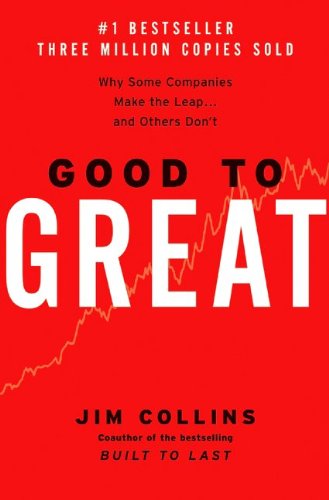
From "Good to Great: Why Some Companies Make the Leap... and Others Don't"
🎧 Listen to Summary
Free 10-min PreviewThe 'First Who' Principle
Key Insight
Executives leading companies from good-to-great implemented a counter-intuitive strategy by first prioritizing getting the right people on the bus and the wrong people off, before determining the company's strategic direction. This approach stemmed from the belief that a team of highly capable individuals can collectively discern the best path forward, adapting and innovating as needed. The initial research expected to find strategy as the first step, but discovered this 'people first' approach was consistently applied by successful transformation leaders.
This 'First Who' principle offers three crucial strategic advantages: First, it enhances organizational adaptability, as people committed to each other rather than a specific destination are more open to changing direction when market conditions shift. Second, it simplifies motivation and management; self-motivated individuals driven by an inner desire to produce excellent results and contribute to greatness require minimal oversight. Third, a compelling vision or strategy becomes largely irrelevant without the right people to execute it effectively, as unsuitable personnel will prevent a company from achieving sustained greatness.
Wells Fargo exemplifies this principle, with CEO Dick Cooley building an exceptionally talented management team in the early 1970s. Anticipating future industry changes without knowing their exact form, Cooley focused on 'injecting an endless stream of talent' into the company, hiring outstanding individuals even without immediate specific roles. This resulted in a team where nearly every member became a CEO of a major company, enabling Wells Fargo to outperform the general market by over three times from 1983, despite its sector falling 59 percent behind. Similarly, Fannie Mae CEO David Maxwell, facing daily losses of 1 million USD and 56 billion USD in underwater loans, prioritized securing 'A players,' replacing 14 of 26 executives to build a top-tier management team before charting a new course.
📚 Continue Your Learning Journey — No Payment Required
Access the complete Good to Great: Why Some Companies Make the Leap... and Others Don't summary with audio narration, key takeaways, and actionable insights from Jim Collins.