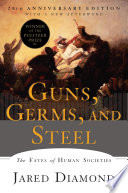
From "Guns, Germs, and Steel: The Fates of Human Societies (20th Anniversary Edition)"
🎧 Listen to Summary
Free 10-min PreviewThe Decisive Role of Germs in European Conquests and Global Population Shifts
Key Insight
Eurasian germs were a more potent force in the European conquest and depopulation of the New World than weapons, killing vastly more Native Americans in bed than on battlefields. These diseases crippled indigenous resistance by decimating populations, eliminating leaders, and demoralizing survivors who witnessed Europeans' mysterious immunity. For instance, in 1519, Cortés's 600 Spaniards encountered a multi-million Aztec Empire; smallpox, introduced by an infected slave in 1520, killed nearly half of the Aztecs, including Emperor Cuitláhuac, and reduced Mexico's population from about 20 million to 1.6 million by 1618.
Similar devastation befell the Inca Empire when smallpox arrived around 1526, killing Emperor Huayna Capac and his designated successor, which led to a civil war that Pizarro exploited with his 168 men in 1531. In North America, Eurasian microbes spread ahead of European explorers; Hernando de Soto in 1540 found Indian town sites abandoned due to epidemics. By the late 1600s, when French settlers reached the lower Mississippi, nearly all large Indian towns, many intact when Columbus arrived, had vanished, with the New World's total Indian population declining by an estimated 95 percent in one to two centuries.
The germ exchange was profoundly one-sided, with numerous Old World diseases devastating the Americas, while virtually no major killers traveled from the New World to Europe. This asymmetry primarily stems from the severe paucity of domesticated animals in the Americas—only five species (turkey, llama/alpaca, guinea pig, Muscovy duck, dog) compared to many Eurasian herd animals. Llamas, for example, were kept in smaller, less dense herds, had limited geographic spread, were not milked, and were not housed intimately with humans, thereby greatly reducing their potential as reservoirs for human crowd diseases.
📚 Continue Your Learning Journey — No Payment Required
Access the complete Guns, Germs, and Steel: The Fates of Human Societies (20th Anniversary Edition) summary with audio narration, key takeaways, and actionable insights from Jared Diamond.