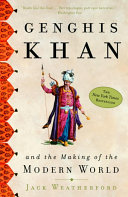
From "Genghis Khan and the Making of the Modern World"
🎧 Listen to Summary
Free 10-min PreviewThe Transformation of Genghis Khan's Image and its Modern Repercussions
Key Insight
While Renaissance writers and explorers openly admired Genghis Khan and the Mongols, the 18th-century European Enlightenment ushered in a growing anti-Asian sentiment that focused heavily on the Mongols as a symbol of everything evil or flawed on the Asian continent. The French philosopher Montesquieu, in his 1748 treatise 'The Spirit of the Laws,' set a dismissive tone, attributing 'detestable qualities' to Asians and blaming Mongols as 'the most singular people on earth' for destroying Asia 'from India even to the Mediterranean.' He contrasted European tribal origins, which he saw as harbingers of democracy, with Asian tribal people, stating that 'There reigns in Asia a servile spirit.' Voltaire, in his 1755 play 'The Orphan of China,' adapted a Mongol dynasty play to depict Genghis Khan as an 'ignorant and cruel villain,' a thinly veiled critique of the French king. Voltaire described Genghis Khan as 'The king of kings, the fiery Genghis Khan/Who lays the fertile fields of Asia waste,' and 'a wild Scythian soldier bred to arms/And practiced in the trade of blood.' This period began the 'modern cursing of the Mongols.' Other artists, like Giovanni Casti, used Mongols as foils in works like his opera 'Kublai, the Great Khan of the Tartars' (1778), which was even suppressed by the Holy Roman Emperor for fear of revolutionary messages. Beyond philosophy and art, the Enlightenment spawned a new breed of intellectuals – scientists – who provided what they claimed was 'dispassionate evidence' for Asian inferiority. The French naturalist Comte de Buffon, in his mid-18th century natural history encyclopedia, offered a 'scientific' description of Mongols, portraying them with large lips, a long, thick tongue, small nose, and dirty-yellow, inelastic skin. He declared Tartar women 'deformed' and their culture as 'strangers to religion, morality, and decency. They are robbers by profession,' a widely translated work that became a foundational source of misinformation.
The German zoologist Johann Friedrich Blumenbach, a professor of medicine from 1776 to 1835, developed zoological classifications for humans based on comparative anatomy, including skin, hair, eye color, skull type, and facial features. He categorized all Asians under the rubric of 'Mongols,' based on the theory that Asians originated in Mongolia, a classification rapidly accepted as scientific gospel in Europe. These categories inherently implied an evolutionary hierarchy, as articulated by Scottish scientist Robert Chambers in his 1844 bestseller 'Vestiges of the Natural History of Creation,' where he asserted the 'Mongolian is an arrested infant newly born' compared to the 'highest or Caucasian type.' Theorists further claimed a close relationship between the 'Mongoloid race' and orangutans, citing similarities in facial traits and postures, such as sitting with folded legs in the 'Mongolian' or 'Buddha' position. The term 'Mongoloid' expanded to encompass American Indians, Eskimos, various Chinese, Tibetans, Turks, Tungus, Koreans, Japanese, and Paleo-Asiatic peoples. This system of classification then inspired its most damaging application: linking 'Mongoloid' features to mental retardation. Chambers first connected retarded children with Asian facial features to incest in 1844. Dr. John Langdon Haydon Down formalized these categories in 1867, suggesting causes like incest, deviant behavior, dietary deficiencies, maternal anxiety, excessive perfume use, paternal alcoholism, and two-headed sperm.
Seeking a historical link, scientists posited that the Mongol invasions of Europe in the 13th century had left a genetic impact on white women through rape, and that these genes occasionally resurfaced as 'throwbacks' in apparently 'normal' European women giving birth to 'Mongoloid' children. Dr. Down's son even refined this, suggesting these individuals were 'pre-human, rather than human.' British physician Francis G. Crookshank's 1924 book 'The Mongol in Our Midst' solidified this link, describing 'Mongolian stigmata' in retarded children and concluding they were 'a race apart,' 'Mongol expatriates' who should be removed from their families. This theory, 'Atavistic Mongolism (or Orangism),' extended to blame 'Occidental Mongols' for crime and feeblemindedness in the West, specifically implicating Jews who supposedly interbred with Khazars and brought 'degraded genetic influence' to Europe. This pseudo-scientific framework provided 'hard and supposedly dispassionate evidence' for the 'Yellow Peril' narrative of the 19th and early 20th centuries. As East Asian nations resisted Western colonization, fear of China and Japan intensified, fueled by their industrialization and refusal of coerced conversion, turning Asians into public enemies. Russian poet Vladimir Sergeevich Soloviev’s 1894 poem 'Pan Mongolism' reflected this fear, envisioning a new 'swarm of waking tribes' from the East comparable to Genghis Khan's invasions. However, in a significant reversal, 20th-century Asian intellectuals and activists, seeking liberation from European domination, found a new hero in Genghis Khan. Figures like Jawaharlal Nehru, the father of Indian independence, reevaluated Genghis Khan as a 'greatest military genius and leader in history,' a 'cautious and careful middle-aged man' who built a 'remarkable civilization,' countering Western narratives of Asian barbarism. Nehru even declared Alexander and Caesar 'petty before him' and was 'fascinated' by Genghis Khan. This led to the concept of Pan Mongolism as a path to a unified Asian identity to resist Western power, including a temporary calendar in Inner Mongolia starting with 1206 as Year 1. Japan, seeking leadership in Asia, even circulated a story of Genghis Khan being a samurai warrior. During World War II, the Soviets, Japanese, and Germans studied Genghis Khan's military tactics, with the German blitzkrieg specifically adapting Mongol strategies. Stalin himself had Timur's body exhumed and launched expeditions to find Genghis Khan's. Post-WWII, Russia and China maintained control over Mongolia, with Soviets purging known descendants of Genghis Khan and attacking his image. Despite these efforts, the memory of Genghis Khan persisted as a powerful symbol, even with the disappearance of his sulde (Spirit Banner) in the 1960s, a testament to his enduring, if contested, legacy as the 'Eternal Spirit of Genghis Khan' and the embodiment of the last great tribal empire that profoundly shaped the modern world.
📚 Continue Your Learning Journey — No Payment Required
Access the complete Genghis Khan and the Making of the Modern World summary with audio narration, key takeaways, and actionable insights from Jack Weatherford.